Key Takeaways:
- AI automates repetitive HR tasks like resume screening and scheduling, but it can’t replace judgment calls, empathy, or complex people decisions
- HR jobs are evolving, not disappearing, and pros who build data skills and strong emotional intelligence will come out ahead
- The future of HR is a partnership between AI and humans, where tech handles the transactional work and people handle the relational and strategic work
If you’re figuring out how to bring AI into your HR processes without losing the human side of things, EBR Software helps companies build smart systems that support their teams instead of replacing them. Want to see how this could work for your HR department? Let’s talk.
What Is AI Already Doing in HR Right Now?
AI is already deep in the HR world. It screens resumes, schedules interviews, answers basic employee questions through chatbots, and predicts which employees might quit soon. Some companies use it to write job descriptions or personalize training based on how someone learns best.
This isn’t some future thing. It’s happening in HR departments everywhere, right now.
Common Myths About AI Replacing HR

Myth — AI Will Replace All HR Jobs
This one gets tossed around a lot, but it’s just not true. AI handles specific tasks really well, especially repetitive, data-heavy stuff. But HR involves way more than tasks. It’s judgment calls, conflict resolution, and understanding what someone’s actually going through. AI can’t touch any of that.
Myth — AI Is Better at Hiring Than Humans
AI processes data faster and catches things humans miss. But “better” isn’t quite right. AI’s good at pattern matching, not at reading between the lines during an interview or knowing when a candidate’s nervous energy actually shows they care. Hiring still needs both.
Myth — HR Automation Will Shrink Teams
Some people think automation means fewer HR jobs. What actually happens is different. Teams shift focus. Less time on admin work means more time on strategy, culture, and solving messy people problems. Headcount doesn’t necessarily drop—the job itself changes.
Myth — AI Can Make Ethical/People Decisions Alone
AI doesn’t get nuance or the messy reality of human relationships. It can flag a pattern, sure. But it can’t decide whether firing someone is right, or how to handle a sensitive harassment complaint. Those decisions need real human judgment, every time.
The Short Answer: What AI Will and Won’t Replace
AI replaces tasks. It doesn’t replace people, at least not entirely. Think of it as taking over the repetitive, transactional parts of HR—resume screening, scheduling, basic Q&A—while leaving the complex, relational, and strategic work to humans. The job changes shape. It doesn’t disappear.
Which HR Tasks & Roles Can AI Automate?

Transactional/Administrative Tasks
Updating employee records, processing time-off requests, generating basic reports. This is where AI shines brightest.
Operational Tasks
Payroll processing and benefits enrollment. AI catches errors humans might miss and speeds everything up.
Recruiting & Sourcing
Screening resumes, ranking candidates, even running initial video interviews. AI handles way more applications than any human team could alone.
Onboarding Coordination
Setting up new hire accounts, assigning training modules, sending welcome materials. AI makes sure nothing slips through the cracks.
Workforce Planning
Predicting staffing needs based on growth, seasonal trends, and turnover. AI spots trends humans might miss until it’s too late.
Compliance Management
Tracking regulatory changes and flagging policy violations. AI catches compliance issues before they turn expensive.
Strategic Tasks
AI feeds strategy with data and predictions, but actual strategic thinking—company direction, culture priorities, big organizational shifts—still needs humans at the wheel.
Relational Tasks
Here’s where AI hits its limits hard. Coaching someone through a career setback, mediating a conflict, supporting someone through a personal crisis. These need real empathy.
The Tools Driving This Shift
Applicant tracking systems, AI chatbots, predictive analytics platforms, and learning management systems are reshaping HR work today. They’re getting smarter and more connected every year.
What AI Cannot Replace in HR
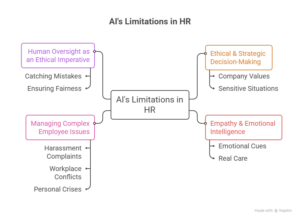
Ethical & Strategic Decision-Making
Deciding company values, handling sensitive situations fairly, making calls that affect people’s lives. AI provides data. Humans make the actual decisions.
Empathy & Emotional Intelligence
Knowing when someone’s struggling, reading emotional cues in a conversation, responding with real care. This is uniquely human, and it’s not even close.
Managing Complex Employee Issues
Harassment complaints, workplace conflicts, personal crises—all need someone who can listen, understand context, and think it through. AI just can’t replicate that.
Human Oversight as an Ethical Imperative
Someone needs to check AI’s work, catch its mistakes, make sure it’s being fair. That job isn’t going anywhere. Actually, it’s getting more important as AI use grows.
HR Employment Growth & Career Outlook
HR jobs aren’t disappearing. Growth projections for HR roles remain strong over the next decade. What’s changing is the skill set. HR pros who understand data, work comfortably alongside AI, and bring strong people skills will do well. Those who only handle admin tasks might find their roles shifting or shrinking.
Trends Shaping the Future of AI + HR

AI as a Team Player, Not a Rival
The most successful companies treat AI as a tool that supports HR teams, not one that competes with them. It’s a partnership.
Making the Most of Agentic AI
Newer AI systems handle multi-step tasks with less human input, like managing entire onboarding workflows or coordinating scheduling across departments. This frees HR up for bigger-picture work.
Predictions for the Next Decade
Expect AI to take on more transactional work, get sharper at predicting employee needs, and become deeply woven into everyday HR software. Human HR pros will spend more time on strategy, culture, and solving complex problems.
How HR Professionals Can Adapt & Future-Proof Their Careers
Learn to work with data and analytics tools. Get comfortable using AI instead of fearing it. Build stronger skills in coaching, conflict resolution, and emotional intelligence—things AI can’t touch. Stay curious about new HR tech, and focus on becoming the person who turns data into decisions that actually help real people.
Conclusion
AI isn’t replacing HR managers and officers. It’s replacing specific tasks, freeing up time for the parts of the job that actually need a human touch. The professionals who adapt, learn new tools, and lean into empathy and strategic thinking will do well. The ones who resist change might struggle, but the field itself isn’t going anywhere.
FAQs
Will AI completely replace HR professionals?
No. AI replaces specific tasks like resume screening and scheduling, but it can’t handle empathy, ethical judgment calls, or complex employee relations. HR jobs are changing shape, not disappearing.
How is AI used in HR today?
AI screens resumes, schedules interviews, answers basic employee questions through chatbots, predicts turnover risk, and personalizes training based on individual learning styles.
How can HR teams prepare for AI?
Start small by automating one process at a time. Train your team on how the tools work, keep humans reviewing important decisions, and stay honest with employees about what data you’re collecting.
What tasks will AI automate, and how does that change the job?
AI handles transactional work like payroll, scheduling, and basic reporting. This shifts HR’s focus toward strategy, culture building, and solving complex people problems that need human judgment.
What skills do HR pros need to work alongside AI?
Data literacy, comfort using AI tools, strong emotional intelligence, and the ability to turn data into decisions that actually matter for real employees.