Key Takeaways
- How HR automation saves time and reduces errors.
- How it makes work better for employees and HR teams.
- How forward-looking tools like AI help companies plan smarter.
Key Benefits of HR Automation for Companies
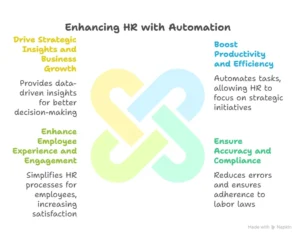
1. Boost Productivity and Efficiency
Imagine a helper who never forgets a single thing. That’s what HR automation feels like. Tasks like payroll, leave approvals, or tracking attendance happen automatically. HR teams can focus on bigger things, while employees spend less time on boring paperwork.
2. Ensure Accuracy and Compliance
Manual HR is full of mistakes—wrong payroll numbers, missed deadlines, or lost forms. Automated systems cut down errors and make sure companies follow labor laws. Fewer mistakes, less stress, and fewer fines.
3. Enhance Employee Experience and Engagement
Employees are fond of simplifying machines. Through HR automation, employees are able to review their payslips, request leave, or update online- no long queues to visit HR. The happier the employees are, the more engagement and reduced turnover generally follows.
4. Drive Strategic Insights and Business Growth
Automation does not merely process things, it gathers information. Companies are able to observe performance, attendance or recruitment trends. Such information helps managers to make a better plan to make decisions that are smart and assist the business to grow.
Future-Focused Benefits of HR Automation
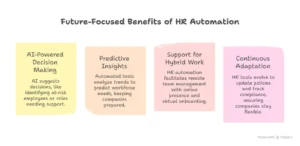
1. AI-Powered Decision Making
Some HR tools use AI to suggest decisions, like spotting employees who might leave soon or identifying roles that need more support. It’s like having a crystal ball that actually works.
2. Predictive Insights for Workforce Planning
Instead of guessing how many people you need next month, automated HR tools analyze trends and make predictions. This keeps companies ready for changes before they happen.
3. Support for Hybrid and Remote Work
The HR automation keeps the wheels turning whether the employees are working at home or in the office. Remote team management is much easier with the use of online presence, digital approval, and virtual onboarding.
4. Continuous Adaptation to Future Work Trends
HR tools keep evolving. They update policies, track new compliance rules, and add features as work changes. Companies stay flexible and ready for whatever comes next.
Challenges and Limitations of HR Automation
Even great tools have some bumps:

- Setup cost: Installing automated systems can be expensive at first.
- Learning curve: Employees need time to get used to new tools.
- Data security: Sensitive info has to be kept safe.
These challenges are usually short-term and manageable with proper training.
Mini Comparison: Manual HR vs HR Automation
| Feature |
Manual HR |
Automated HR |
Benefit |
| Payroll Accuracy |
Errors common |
Automated, accurate |
Saves time & prevents mistakes |
| Leave Approvals |
Paper-based |
Self-service |
Faster, reduces HR workload |
| Compliance |
Hard to track |
Automated reports |
Reduces risk of fines |
See the difference? Automation takes the boring, error-prone tasks off everyone’s plate.
Real-Life Example of HR Automation Benefits
Take a company with 200 employees. Payroll used to take three days each month and often had mistakes. With the switch to HR automation, payroll can be run in a few hours with practically no mistakes. HR personnel no longer pursue forms, but are focusing on the coaching and engagement of workers. People are all happier, and the company is more organized.
FAQs About HR Automation Benefits
What processes benefit the most from automation?
Payroll, leave management, compliance tracking, recruitment, and onboarding improve the most.
How does HR automation improve compliance?
Automated systems track deadlines, generate reports, and flag potential issues so companies stay on top of labor laws.
Can automation replace HR managers?
Nope. It helps HR teams work smarter, but human judgment, coaching, and problem-solving are still essential.
How quickly can a company see results?
Some improvements, like faster payroll and leave approvals, happen immediately. Strategic insights grow over months as data accumulates.
Conclusion
HR automation does more than speed things up—it helps work feel calmer and more organized for everyone. When the small, repetitive tasks run on their own, HR teams can focus on people instead of paperwork. Employees get quicker answers, managers get clearer information, and the whole company moves with fewer bumps in the road.
It does take some setup and learning at first, but the payoff shows up quickly. As automation tools get smarter with AI and better analytics, businesses can plan ahead with more confidence. And with EBR Software, companies get HR tools that stay simple to use, dependable, and ready to support them as they grow.