Key Takeaways:
- AI is capable of carrying out routine work in HR, such as screening resumes and managing benefits, which thus allows HR staff to have more time for strategic planning and genuine human interaction.
- Well-managed use of AI may lower the hiring bias and also facilitate making hiring decisions on the basis of data, but one has to be constantly vigilant to prevent problems that existed before from getting things go south.
- The future isn’t about AI replacing humans—it’s about using tech for routine stuff while people handle the complex, emotional work that needs empathy and judgment.
Positive Effects of AI Tools on HR
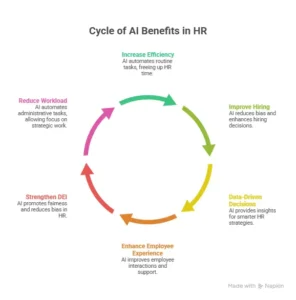
Increased Efficiency and Productivity
Imagine you had to manually examine 500 of resumes. Now picture AI completing the task in roughly ten minutes. It looks through the applications, sorts the candidates depending on your criteria, and marks the top ones for your checking.
But it’s not just hiring. AI chatbots answer benefits questions at midnight. Automated systems approve time-off requests, update records, and create reports that used to eat up entire afternoons. What this really means is HR people get their time back. They can actually have conversations, fix problems, and plan for what’s coming instead of drowning in spreadsheets.
Improved Quality of Hiring Decisions
We humans are not so good at choosing the most suitable employees. Often, we tend to hire people who have studied at particular schools or who, in a way, resemble ourselves. There are certain biases in our nature that we are not even aware of.
AI changes this. When it’s set up right, it looks at stuff that actually matters—skills tests, work samples, how someone handles real situations. It doesn’t care about resume gaps or fancy degrees. Just whether you can do the job. Companies end up with better hires who stay longer, which saves everyone a ton of hassle.
Data-Driven HR Decision-Making
HR used to work on gut feelings. “Morale seems low” or “We should probably hire more people.” AI brings real numbers to these conversations.
These tools spot patterns nobody would catch otherwise. Maybe people on certain projects always get promoted faster. Maybe one department has way more people leaving than others. With actual data, HR can make smarter calls about pay, training, career paths—all of it.
Enhanced Employee Experience
Waiting three days for a vacation approval? That’s done. AI handles routine requests instantly.
But it goes deeper. AI may propose various trainings according to your professional goals, help your finding mentors who’ve already experienced where you want to go, or even tell when you are starting to get tired. If you do it properly, it feels less like going through obstacles and filling out the forms, and more like engaging with something that really fulfills your dreams.
Stronger Diversity, Equity, and Inclusion (DEI) Efforts
Take humans out of early hiring stages, and you can cut down on bias. AI doesn’t see age, gender, race, or whether your name sounds “different.”
Some companies use AI to rewrite job posts so they don’t accidentally push certain people away. Others use it to keep interview questions consistent. AI can also flag pay gaps or promotion patterns that show something’s off. It’s not perfect—we’ll get to the problems—but it can help make things fairer.
Reduced Administrative Workload
Let’s be real: tons of HR work is just boring admin. Updating files. Sending reminders. Scheduling stuff. AI crushes this kind of work, which means HR people can focus on things that actually need a human—like coaching managers, solving conflicts, or helping someone through a rough patch.
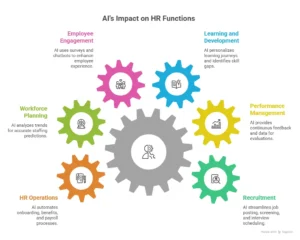
Key HR Functions Impacted by AI Tools
Recruitment and Talent Acquisition
This is where AI shows up the most. It writes job posts, publishes them everywhere, screens applications, schedules interviews, and sends out tests to candidates. Some systems even do first-round video interviews where they analyze what people say and how they say it.
Others predict which candidates will actually accept your offer, so you don’t waste time on dead ends. Processes that took months now happen in weeks.
Performance Management and Evaluation
Annual reviews are pretty outdated. You’re asking managers to remember what someone did almost a year ago. They can’t, not really.
AI tracks everything continuously. It gathers feedback from multiple people, watches project completions, even looks at how well someone collaborates. When review time hits, managers have real data instead of fuzzy memories.
Learning and Employee Development
Everyone learns differently. Some people love reading. Others need videos. Some want hands-on practice. AI understands what helps you learn best and creates a customized learning journey for you.
It suggests courses to you, changes the level of challenge depending on your performance, and recognizes your weak areas even before they turn into issues. Say, if no one in the engineering department is aware of some latest tech that is gaining enormous popularity, AI can highlight it and offer training.
Employee Engagement and Experience
AI-powered surveys keep track of people more often, not just once a year, as was done before. Chatbots can answer simple queries about benefits, time off, personal info update, etc. – things that don’t require a human.
AI can also predict who’s about to quit. It looks at engagement scores, benefit usage, internal job applications, and dozens of other signals. This gives HR a heads-up to maybe fix things before someone leaves.
Workforce Planning and People Analytics
How many people do you need next quarter? Which teams are stretched too thin? What skills matter two years from now? AI analyzes trends and makes actual predictions instead of guesses.
It looks at growth patterns, seasonal changes, turnover rates, and market conditions to forecast what you’ll need. You can plan ahead instead of scrambling when you’re already underwater.
HR Operations and Process Automation
This is background stuff that makes everything run. AI handles onboarding—getting new hires their equipment, system access, required training. It manages benefits enrollment, answers insurance questions, and catches payroll errors before they cause problems.
Challenges and Risks of AI Tools in HR
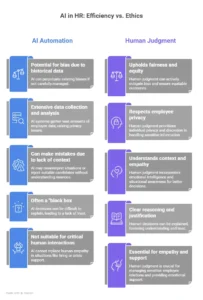
AI sounds great, but let’s talk about what goes wrong.
Bias is the major one. AI learns from data, and if that data is distorted, the AI will be too. A few hiring tools have been guilty of discriminating against women just because they learned from companies that used to hire mostly men in the past. The AI basically learned to be sexist without anyone meaning for that to happen.
Privacy is another issue. AI collects massive amounts of data about employees—work patterns, break times, communication style, even facial expressions on video calls. That’s creepy, and people feel like they’re being watched constantly. Not great for trust.
AI makes mistakes. A lot. It might reject a perfect candidate because their resume looks weird, or not understand that someone takes frequent short breaks for medical reasons. These systems don’t get context like humans do.
There’s also the transparency problem. A lot of AI is a “black box”—it makes decisions but can’t explain why. If it rejects your application, you might never know the real reason. That feels unfair and makes it hard to improve.
Of course, some decisions just shouldn’t be automated. For example, firing someone, managing a case of harassment, or emotionally supporting an employee through a crisis, these need human judgment and empathy. AI can help, but it can’t replace the human part of HR.
How AI Is Changing the Role of HR Professionals
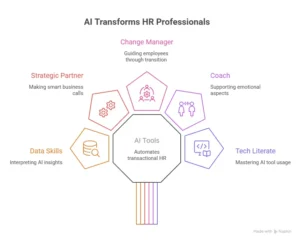
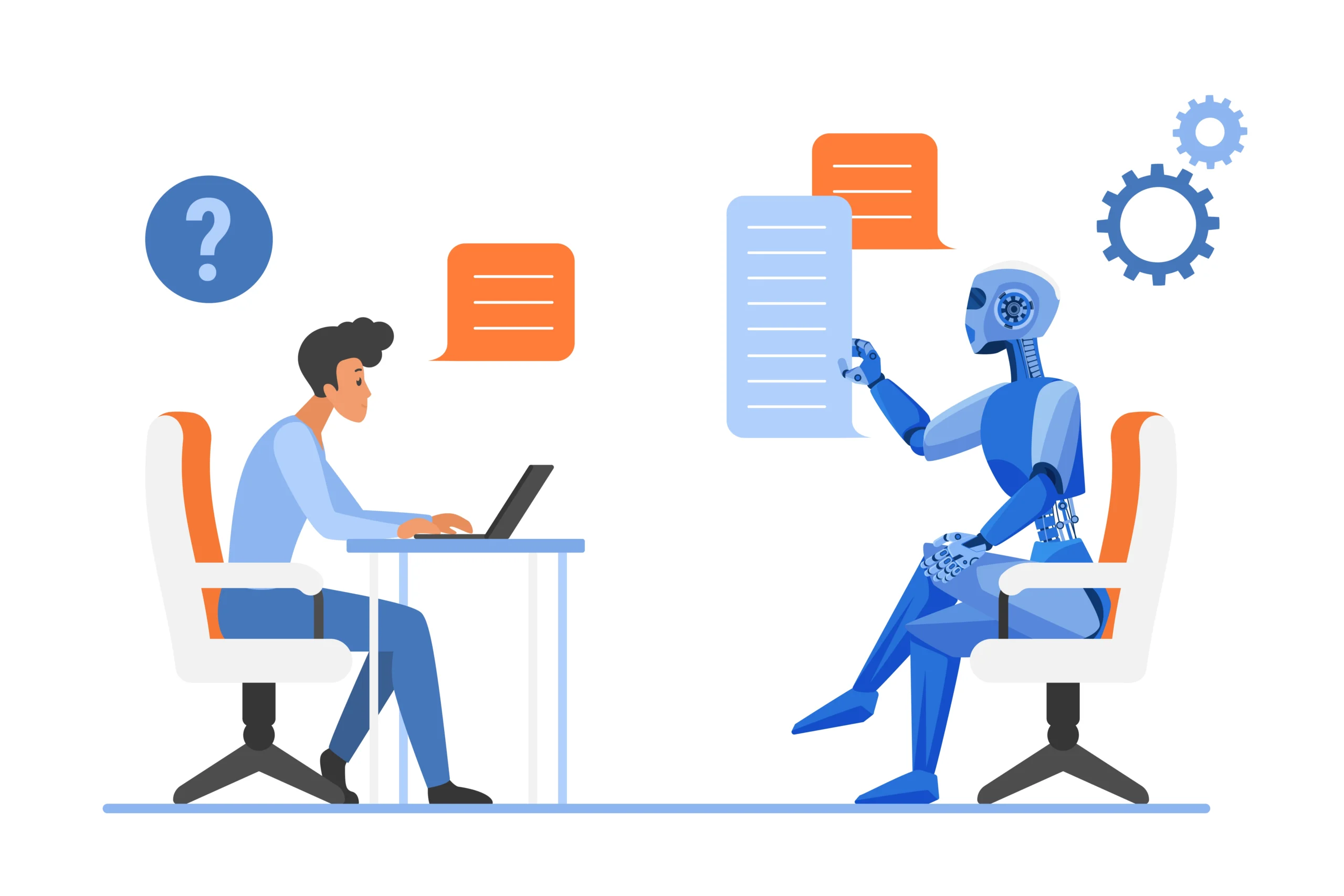
If you work in HR, your job probably looks different from what it did a few years ago. AI handles the transactional stuff, which means you need different skills now.
You need to understand data. You need to interpret what AI tells you and make smart calls based on it. You’re becoming a strategic partner instead of a paperwork processor.
HR professionals have also taken on the role of change managers, guiding the employees through the transition and integrating new technologies with the changes in work style. They are coaches, supporting the emotional aspects of human interactions that AI is incapable of understanding. Besides, they are becoming technologically literate, mastering the use of AI tools and even training them.
The jobs aren’t disappearing. They’re evolving. The companies doing it right use AI for routine work so their HR teams can do more meaningful stuff.
Best Practices for Using AI Tools in HR
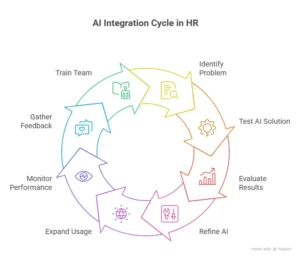
Starting small works best. Pick one problem—maybe resume screening—and test AI there. Learn what works, fix what doesn’t, then expand.
Watch out for bias. Test your tools regularly to catch discrimination. Have humans review AI decisions. Be ready to override it when needed.
Keep humans in charge of big decisions. AI can suggest and analyze, but people should make final calls about hiring, firing, and promotions.
Be honest with employees. Tell them when AI’s being used and how. Explain what data you’re collecting and why. Trust matters.
Train your HR team. They need to know how the AI works, what it can’t do, and how to use it right.
Check in regularly. Just because something worked when you started doesn’t mean it’s still working well. Get feedback and be ready to change things.
The Future Impact of AI Tools on HR
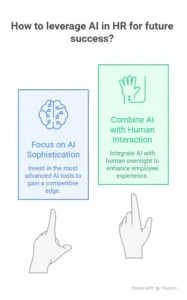
Looking ahead, AI in HR is getting way more advanced. We’re headed toward fully personalized employee experiences where your training, schedule, and projects are all customized by AI based on your goals and how you work best.
Predictive analytics will get sharper. AI won’t just say someone might quit. it can even tell you the reasons behind it and suggest a solution. It may forecast employee burnout, internal conflicts, or a source of new talent.
Winners will not be the companies with the most sophisticated AI. Rather, they will be those who manage to combine AI with genuine human interaction. After all, people prefer to be led by people, not machines.
Conclusion
AI is profoundly changing the face of the Human Resources industry at present. It quickens the procedures, provides companies with the power to base their decisions on data, and can help create more equitable workplaces. Nevertheless, it is not without its drawbacks; there exist biases and privacy problems, besides the risk of losing human touch, which is a valid concern.
If you’re ready to bring AI into your HR processes the right way, EBR Software helps companies implement smart, ethical AI solutions that make HR teams more effective without losing what makes them human. Want to see how AI can work for your HR department? Let’s talk.