Key Takeaways
- ERP systems bring your finances, operations, and customer data into one place — reducing errors and saving time.
- Budget-friendly options like Odoo, Zoho, and EBR make ERP accessible for startups at every stage.
- The best time to implement ERP is before your manual processes start breaking down — not after.
Top Budget-Friendly ERP Solutions for Startups
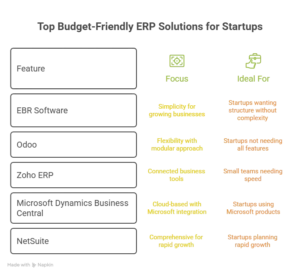
Several ERP platforms deliver strong features without the enterprise price tag.
EBR Software
EBR is built with growing businesses in mind. It helps startups manage financial operations, workflows, and reporting — all in one place. The platform focuses on keeping things simple so small teams don’t get overwhelmed. It’s a solid choice if you want structure without complexity.
Odoo
Odoo is an open-source ERP platform known for its flexibility. You start with the modules you need and add more as your business grows. It’s popular with startups because you’re not paying for features you won’t use for another two years.
Zoho ERP
Zoho brings together a collection of connected business tools — finance, CRM, project management, and reporting. It’s easy to set up and works well for small teams that need to move fast without a steep learning curve.
Microsoft Dynamics Business Central
Business Central is a cloud-based ERP with strong financial and operational tools. Many startups adopt it early because it connects smoothly with other Microsoft products they’re already using.
NetSuite
NetSuite is a more comprehensive platform designed for companies planning rapid growth. It covers advanced financial management, automation, and reporting. If you’re scaling fast and want a system that grows with you from day one, it’s worth considering.
Why Startups Need ERP Systems
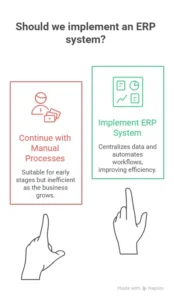
In the early days, most startups run on manual processes. Spreadsheets track the finances. Email threads manage orders. Customer data lives in three different places.
That approach has a shelf life.
As the Startups picks up pace, manual processes slow you down. Teams spend more time looking for information than acting on it. Decisions get delayed because nobody has the full picture.
ERP systems solve this by centralizing everything. One platform for your data, your workflows, and your reports. Teams move faster, make fewer mistakes, and spend less time on tasks that should be automated.
Challenges Startups Face Without ERP
Running without an ERP system creates real problems — and they tend to get worse over time.
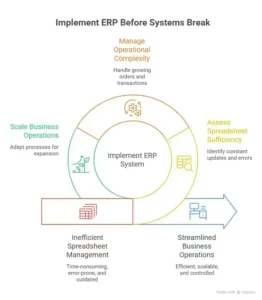
Disconnected tools and data silos
When different departments use different tools, information gets scattered. Finance is in one system, sales in another, and operations somewhere else. Nobody has a complete view of what’s happening. Data silos make collaboration harder and decision-making slower.
Manual workflows slowing operations
Manual processes take time and leave room for mistakes. As transaction volumes increase, these workflows become harder to keep up with. What worked when you had ten customers doesn’t work when you have a thousand.
Limited real-time reporting
In the absence of a centralized system, retrieving reliable reports is a demanding task. Executives frequently have to depend on historical data or partial information. It becomes really an issue if you want to react promptly to market fluctuations.
When Should a Startup Implement ERP?
A lot of startups wait too long. The right time to implement ERP is before your current systems start breaking down — not after.
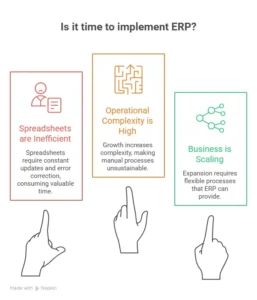
Signs spreadsheets are no longer sufficient
Spreadsheets are excellent tools for basic tracking tasks. But if your team is constantly engaged in updating the spreadsheets, fixing errors, or handling various versions, this might well be the sign that spreadsheets are no longer suitable for your needs. If maintaining spreadsheets as accurate becomes such a significant task that it takes up most of your time then you should consider moving on.
Operational complexity during growth
More customers, more orders, and more financial transactions mean more moving parts to manage. Manual processes can’t keep up. ERP systems help startups handle growing complexity without losing control.
Scaling business operations
When expanding to new markets, introducing new product lines, or increasing your team size, your processes must change rapidly. ERP systems offer you the ability to grow and change scales without having to overhaul everything from scratch.
What Makes an ERP Solution Budget-Friendly?
Not every ERP platform is out of reach for a startup. Several features keep costs manageable.
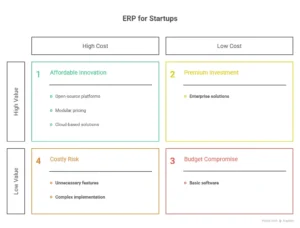
Cloud-based ERP solutions
Cloud platforms remove the need for expensive hardware and on-site infrastructure. You access everything through the internet, which cuts upfront costs significantly. Most cloud ERP systems also handle updates automatically, so there’s less ongoing maintenance to worry about.
Open-source ERP platforms
Open-source ERP systems let you customize the software without paying large licensing fees. This works well for startups that have a technical team and want more control over their setup.
Modular pricing models
Some ERP platforms let you pay only for the features you actually need. You start small and add more modules as your business grows. This way, you’re not overpaying for capabilities you won’t use for months or years.
Low implementation and maintenance costs
The best budget-friendly ERP tools are designed to be straightforward to set up. Simpler implementation means lower costs up front — and lower ongoing maintenance costs over time.
Key Features Startups Should Look for in ERP
When comparing platforms, focus on the features that support your daily operations.
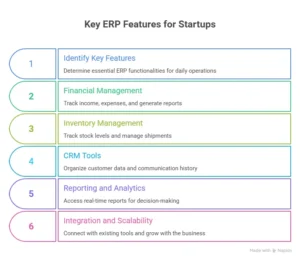
Financial management
Good financial tools track income, expenses, and generate clear reports. You get a real-time view of your financial health, which makes planning and budgeting a lot easier.
Inventory and supply chain management
Inventory features help you track stock levels, manage shipments, and stay on top of supplier relationships. This is especially useful for startups handling physical products.
Customer relationship management (CRM)
CRM tools keep your customer data, sales activity, and communication history organized. Your team spends less time digging through emails and more time building relationships.
Reporting and analytics
Real-time reports help you spot trends, track performance, and make smarter decisions. The faster you can access accurate data, the faster you can act on it.
Integration and scalability
Your ERP system should connect easily with the tools you already use — payment platforms, marketing software, and more. It also needs to grow with your business, not hold it back.
ERP Pricing Models Explained
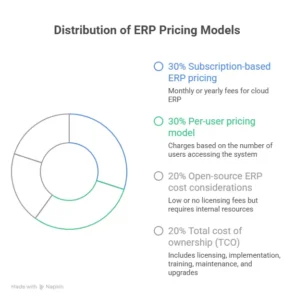
ERP platforms price things differently. Understanding the models helps you avoid surprises later.
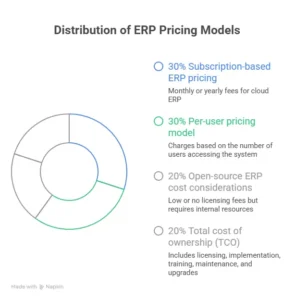
Subscription-based ERP pricing
Many cloud ERP systems charge a monthly or yearly fee. This spreads costs over time instead of requiring a large upfront payment. It’s a popular model for startups because it keeps cash flow more predictable.
Per-user pricing model
Some platforms charge based on the number of users accessing the system. This approach is quite suitable for the small group. When you are recruiting more individuals, your expenses increase slowly instead of suddenly rising.
Open-source ERP cost considerations
While open-source systems generally have low or no licensing fees, they might still need your time and other internal resources if you want to develop, set up, and maintain them. So make sure you include these costs when you make up your mind.
Total cost of ownership (TCO)
The sticker price is never the whole story. The total cost of ownership covers not just the licensing fees, implementation, training but also maintenance, and upgrades. Having a clear picture of TCO upfront will help you steer clear of the costs that come as a surprise later on.
Steps to Successfully Implement ERP in a Startup
A structured approach makes ERP implementation a lot smoother.
Identify business requirements
Start by figuring out which processes need the most help. What’s breaking down? Where is time slipping away? Getting to grips with what you truly need will help you to focus on the right platform rather than being sidetracked by features that you don’t require.
Choose the right ERP system
Besides features, pricing, and ease of use, compare the platforms in terms of room to grow. Don’t go for the most popular one only, choose one that suits your current situation and future direction of your business.
Data migration and system setup
Data migration is a delicate process, and it demands a lot of care and attention. Careless migration of data results in mistakes, which are quite challenging to amend later. It is a good idea to spend time on preparing/cleaning your data before migrating it and also, initially configure the system well.
Employee training and adoption
A platform that no one knows how to use is not helping anybody. Provide your team with the time and training they require in order to get used to the platform. The more the team is self-assured, the sooner you will witness the results.
Continuous monitoring and optimization
Launching your implementation is only the first step. Be sure to continually monitor the system’s performance, solicit your team’s input, and tweak the system accordingly. Tiny changes made at the beginning rarely result in a time-consuming process.
How EBR Supports Startups with Budget-Friendly ERP Solutions
Startups need systems that are flexible, easy to use, and won’t blow their budgets. EBR is built exactly for that.
With this platform, one can help make business growth, manage financial processes, automate routine workflows, and generate reports, all of which happen inside a single system. The platform also plans things logically so as not to confuse small teams with a lot of complexities.
As your startup scales, EBR scales with you. It’s designed to stay simple and manageable even as your operations grow more complex.
Conclusion
Managing a growing startup with disconnected tools and manual processes only works for so long. At some point, scattered data and slow workflows start costing you time, money, and opportunities.
Affordable ERP solutions make it possible to get organized early — without stretching your budget. If you choose the right platform, your team will have just one source of truth, their decision-making will be much faster and it will be easier to build a strong basis for growth.
Depending on whether you’re just starting up or experiencing the pains of growth, a budget-friendly ERP solution will be able to match your business’s current state.