Key Takeaways
- Define your real operational requirements before evaluating any software. Volume, deployment environment, integration needs, and compliance requirements all shape which solution is actually right for your business.
- OCR accuracy, Arabic language support, chip reading capability, and integration flexibility are the four technical factors that separate genuinely capable solutions from ones that create more problems than they solve.
- Vendor expertise in the UAE market matters as much as the software itself. Emirates ID specifications change, regulations evolve, and you need a partner who keeps pace — not one who treats the UAE as a secondary market.
Why Choosing the Right Emirates ID Reader Software Matters
The process of verifying someone’s identity is central to customer onboarding, employee management, and meeting regulations in almost all industries in the UAE.
When done correctly, the process is very quick, correct, and completely papered trail is present. On the other hand, when you get it wrong, the results are data mistakes, legal liability, and a disappointing customer interface all of which is detrimental to your brand.
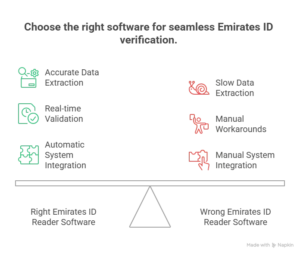
The Emirates ID Reader Software contains rich data — both on the card’s surface and in its embedded chip. The right software extracts all of it accurately, validates it in real time, and connects it to your systems automatically.
The wrong software does some of that, slowly, and creates manual workarounds for the rest.
How to Choose the Best Emirates ID Reader Software — Step by Step
Step 1: Define Your Business Requirements First
Before you look at any software, get clear on what you actually need.
How many identity verifications do you process daily? Are you verifying customers, employees, or both? Do you need kiosk deployment, mobile scanning, web integration, or a combination?
Start with your real operational needs. Don’t let a vendor’s feature list define your requirements for you.
Step 2: Evaluate OCR Accuracy and Performance
OCR accuracy is the most important technical factor in Emirates ID reader software. A system that misreads characters, struggles with worn cards, or fails on certain fonts creates more problems than it solves.
Ask vendors for accuracy benchmarks on Emirates ID specifically — not generic document scanning accuracy. Test the software with a range of real cards, including older and slightly worn ones.
Speed matters too. If verification takes longer than a few seconds per card, it creates friction in high-volume environments.
Step 3: Ensure Arabic and English Language Support
Emirates IDs contain data in both Arabic and English. Your software needs to extract both accurately — not just one language with the other as an afterthought.
This is particularly important for name fields, address data, and any records that need to match official Arabic-language documents or government systems.
Test Arabic extraction specifically. Don’t assume it works because the vendor says it does.
Step 4: Assess Integration Capabilities
Emirates ID reader software that doesn’t connect to your existing systems creates a data island. Someone still has to manually transfer information — which defeats most of the purpose.
Check what APIs and connectors are available. Does it integrate with your CRM, HRMS, ERP, or patient management platform? How long does integration typically take? Is it something your internal team can handle or does it require the vendor’s professional services team?
Integration capability is often where the real difference between solutions shows up.
Step 5: Review KYC and Compliance Support
The ability of the bank or financial service company to verify identities is not only an operational matter, it’s mandated at law. It is a similar regulatory requirement in identity verification that also applies to healthcare providers and governments.
Along with the above features, compliance with UAE rules about data retention is very important. Thus, your solution shall comply with the regulations regarding customer verification steps, keeping track of every verification step by generating verification logs, and securely storing verification data.
Ask specifically about compliance features. Can the system produce the documentation you’d need in the event of a regulatory audit? Does it flag expired IDs automatically? Does it maintain a complete, timestamped verification log?
Step 6: Prioritize Security and Data Protection
Emirates ID data is sensitive personal information. How your software handles, stores, and transmits that data matters — both ethically and legally.
Look for end-to-end encryption of captured data, secure storage that meets UAE data protection standards, role-based access controls so only authorised staff can access verification records, and clear data retention and deletion policies.
Ask the vendor directly where data is stored, who can access it, and what happens to it after the retention period ends. A vendor who can’t answer these questions clearly isn’t one you want handling identity data.
Step 7: Consider Scalability and Future Growth
A solution that handles your current volume comfortably should still handle three times that volume without needing a complete replacement.
Think about where your business is going. Are you opening new locations? Expanding to new customer segments? Planning to add new verification use cases? Your software needs to grow with you.
Ask about licensing models too. Per-scan pricing that works at low volume can become expensive quickly as you scale.
Step 8: Evaluate Vendor Support and Expertise
Emirates ID reader software isn’t something you set up once and forget. Cards get updated. Regulations change. Integration requirements evolve.
You need a vendor who provides responsive technical support, proactively updates their software when Emirates ID specifications change, and has genuine expertise in UAE identity verification — not just a generic document scanning product adapted for the region.
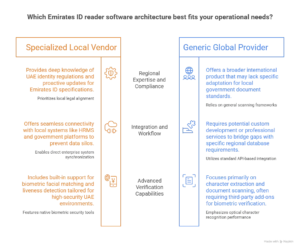
Ask about their UAE client base, their update history, and how they communicate changes that affect the software. A vendor with deep UAE experience is worth prioritising over one with a broader international product and limited local knowledge.
Step 9: Consider Biometric Identity Verification Needs
Some use cases require more than data extraction from the card. They require verification that the person presenting the card is actually the card’s owner.
If your use case involves high-security environments, financial account opening, or regulatory requirements for biometric verification, make sure the software supports facial matching, liveness detection, or integration with biometric verification systems.
Not every business needs this. But if yours does, it needs to be built into your selection criteria from the start — not retrofitted later.
What to Look for in Emirates ID Reader Software — Key Features Checklist
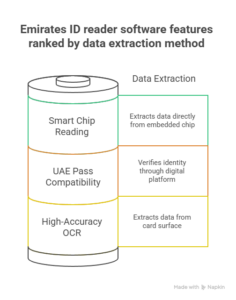
Smart chip reading pulls data directly from the card’s embedded chip — the most accurate and secure extraction method available. If a solution doesn’t support chip reading, it’s missing a significant capability.
High-accuracy OCR for both Arabic and English handles the full data set on the card’s surface, including fields that chip reading may not cover.
Real-time validation checks extracted data against authoritative sources at the point of capture, flagging expired cards, mismatched data, or verification failures immediately.
Multi-platform deployment supports web, mobile, and kiosk environments so you can deploy the software where your verification actually happens.
API-first integration makes it straightforward to connect the software to your existing business systems without complex custom development.
Audit trail and compliance logging maintains a complete, timestamped record of every verification for regulatory and internal audit purposes.
Data encryption and security standards protect captured identity data both in transit and at rest, meeting UAE data protection requirements.
UAE Pass compatibility supports digital identity verification through the UAE’s national digital identity platform alongside physical card scanning.
Scalable licensing allows your verification capacity to grow alongside your business without forcing a platform change.
Common Mistakes to Avoid When Selecting Emirates ID Reader Software
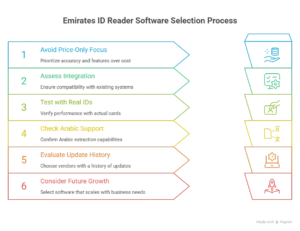
The most common mistake when buying is only considering price. In fact, the solution at the lowest price is usually not a match for the accuracy, ability to be integrated, level of support, etc., that you actually require. The cost of poor performance — in errors, manual workarounds, and compliance risk — almost always exceeds any saving on the licence fee.
Skipping the integration assessment creates expensive problems after purchase. Always verify compatibility with your specific systems before you commit.
Not testing with real Emirates IDs means demo performance doesn’t translate to real-world performance. Test with actual cards — including older, worn, and laminated ones — before signing anything.
Ignoring Arabic language support is a mistake that surfaces quickly in production. Make sure Arabic extraction is tested, not assumed.
Overlooking vendor update history matters more than most buyers realise. Emirates ID specifications have changed over time and will change again. A vendor who hasn’t updated their software to keep pace is one whose product will eventually fail.
Focusing only on current volume without thinking about growth leads to a platform change sooner than expected. Choose for where your business is going, not just where it is now.
Questions to Ask Before Choosing an Emirates ID Reader Software Vendor
What document types does the solution support?
You need Emirates ID as a primary — but also ask whether the software handles passports, driving licences, and other UAE identity documents if your use case requires it.
How accurate is the OCR engine for Emirates ID?
Ask for benchmarked accuracy figures specifically for Emirates ID, not general document accuracy. Ask how performance holds up on worn or older cards.
Does it support Arabic and English data extraction?
Ask for a demonstration of Arabic field extraction specifically. Confirm that both languages are extracted with equal accuracy.
What integration options are available?
Ask about available APIs, pre-built connectors for common platforms, and the typical time and effort required for integration with systems like yours.
How does it handle data privacy and security?
Inquire about where the data is stored, the method of its encryption, the individuals who can access it, the duration of its retention, and the process involved in deletion. Also, find out if the data handling solution adheres to UAE data protection laws.
How to Download and Use the Digital Emirates ID
Emirates ID is now a digital entity of the UAE and can be used through the UAE Pass app. It is a way for the residents to digitally show their IDs and get verified through their mobile phones, no need to carry physical cards.
To access the digital Emirates ID, download the UAE Pass app from the App Store or Google Play. Complete identity verification within the app using your physical Emirates ID and facial recognition. Once verified, your digital Emirates ID is accessible within the app and can be shared digitally for verification purposes.
Businesses adopting Emirates ID reader software should confirm that their chosen solution supports digital ID verification alongside physical card scanning. As digital adoption grows, solutions that handle both will become increasingly important.
Conclusion
Choosing Emirates ID reader software isn’t a decision to make quickly. The right solution needs to match your verification volume, integrate with your systems, meet your compliance requirements, and support how your business will grow.
Take the time to define your requirements first, test with real cards, assess integration capability properly, and ask vendors the hard questions before you commit.
The businesses that get this right end up with a verification process that’s faster, more accurate, and more compliant than what they had before — with less manual effort and fewer errors across the board.
At EBR, we help UAE businesses implement Emirates ID reader software that fits their specific operation — from initial requirements assessment through to integration, deployment, and ongoing support.