Key Takeaways
- Most SMB’s rely on top HR software that combines all essential features in a single platform, such as payroll, onboarding, leave management, and compliance. This way, they can operate the software without hiring a specialist.
- Start with your biggest pain point, not the longest feature list.
- The easiest option that a small or medium business could go for in terms of HR, is definitely an all boldy rounded one like EBR. The reason being is that it is a complete and scalable HR solution that would be in line with their size and budget.
Why SMBs Need Specialized HR Software
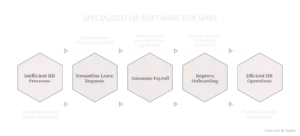
The majority of the small businesses initially handle their HR through the use of spreadsheets and email chains. It seems to be working up to a point.
As headcount grows, things start slipping. Leave requests get missed. Payroll takes hours. New hires don’t get a proper onboarding experience.
Generic tools aren’t built for this. Enterprise systems are too complex and too expensive. What SMBs need is something powerful enough to handle real HR work but simple enough that anyone can use it.
That’s exactly what the tools on this list are designed for.
The Best HR Software for Small and Medium Businesses

1. EBR — Best Overall HR Software for SMBs
EBR is built specifically for small and medium businesses that need a complete HR solution without the enterprise price tag.
It tackles all HR aspects at a single platform, payroll, leave management, new hire processing, performance evaluation, and compliance. The clean and user-friendly interface truly helps your team to embrace the software rather than reverting to spreadsheets.
What makes EBR stand out is how well it scales. It doesn’t matter if your company only has 10 staff or 500 employees, the system adjusts perfectly to your growth. Installation is quick, the customer service is very helpful, and the pricing is very reasonable for companies that are concerned about their budget.
2. Gusto — Best for Payroll and Startups New to HR Software
Gusto is one of the most popular HR tools for small businesses. Payroll is where it really shines — automated, accurate, and easy to run even if you’ve never done it before.
It also covers benefits administration, basic onboarding, and compliance tools. For a startup just getting its HR foundation in place, Gusto is a solid starting point.
The limitation is depth. As your needs grow more complex, you may find yourself needing more than Gusto offers.
3. Rippling — Best for HR Automation and IT Management
Rippling combines HR and IT management in one platform. You can onboard a new hire, set up their laptop, assign software access, and run payroll — all from the same system.
For tech-forward companies or businesses with lots of remote employees, that combination is genuinely useful. Automation is a strong point too.
It’s more expensive than most options here, so it makes most sense for businesses that will actually use the IT side of the platform.
4. Zoho People — Best for Affordability
If budget is your primary concern, Zoho People is worth a serious look. It covers core HR functions — attendance, leave, performance, and payroll integration — at a price point that’s hard to beat.
It’s part of the wider Zoho ecosystem too. If you’re already using Zoho CRM or Zoho Books, everything connects cleanly.
The interface isn’t the most modern, but for the price, it delivers solid value.
5. Paycor — Best for Growing Businesses
Paycor is built for businesses that are scaling. It covers payroll, talent management, scheduling, and analytics in a way that holds up as headcount climbs.
The reporting tools are a real standout. You get clear visibility into workforce costs, turnover, and compliance status.
It’s not the simplest tool to set up, but for a business planning serious growth, it’s worth the investment.
6. Deel — Best for Global and Remote Teams
If you have staff or contractors located in different countries, Deel can be the solution to a tough problem. It manages global payroll, contractor payments, and compliance in over 150 countries.
If SMB’s are going global or creating remote-first teams, Deel takes away the legal and financial difficulties of paying employees in different countries.
It’s not a full HR suite, but for international workforce management it’s the strongest option available.
7. GoCo — Best for Ease of Use and Small Teams
GoCo is designed to be simple. The onboarding experience is smooth, the interface is intuitive, and most small teams get up and running without much training.
It covers the essentials — onboarding, benefits, time off, and document management — without overwhelming you with features you don’t need.
For a small business with no dedicated HR person, that simplicity is a genuine advantage.
8. Homebase — Best for Hourly and Shift Workers
Homebase is built for businesses with hourly staff — restaurants, retail, service businesses. Scheduling, time tracking, and payroll for shift workers are where it excels.
If most of your team works shifts, Homebase handles scheduling conflicts, overtime alerts, and hourly payroll better than almost anyone else on this list.
It’s not the right fit for office-based or salaried teams, but for its target audience it’s excellent.
9. HiBob — Best for Team Culture
HiBob puts real emphasis on employee experience alongside standard HR functions. Engagement surveys, recognition tools, culture tracking, and team visibility are all built in.
HiBob equip businesses that prioritize culture and retention with the right tools to effectively gauge, improve and grow these aspects.
It’s best suited for mid-sized businesses rather than very small teams, and pricing reflects that.
10. Paylocity — Best Mobile-First Experience
Paylocity is built with mobile in mind. Employees access payslips, request leave, complete surveys, and update their information from their phone without any friction.
For businesses with a workforce that’s rarely at a desk — field teams, remote workers, distributed staff — that mobile experience makes a real difference.
HR functions across payroll, benefits, and engagement are solid throughout.
How We Selected the Best HR Software for SMBs

Every tool on this list was evaluated on the same criteria — ease of use, core HR features, pricing transparency, integration options, customer support, and how well each tool scales.
We also paid attention to who each tool is actually built for. An enterprise system dressed up for SMBs didn’t make the cut.
The tools here are genuinely designed for smaller businesses — in pricing, complexity, and support.
Challenges SMBs Face Without HR Software

Without a proper HR system, small businesses run into the same problems over and over.
Payroll errors happen when you’re working from spreadsheets. One mistake and you’ve got an unhappy employee and a compliance problem.
Onboarding becomes inconsistent. New hires get different experiences depending on who manages their first week. Important documents get missed.
Leave tracking turns into a mess. One person gives their approval via WhatsApp, no one updates the spreadsheet and ultimately two staff members take the same time off.
And compliance slips through the cracks. Employment law changes, contracts expire, certifications lapse. Without a system tracking it all, things get missed.
Honorable Mentions
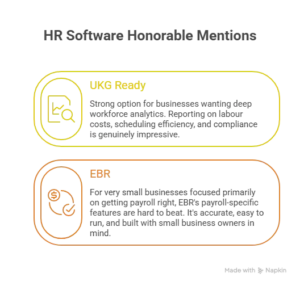
UKG Ready — Best for Robust Analytics
UKG Ready is a strong option for businesses that want deep workforce analytics. Reporting on labour costs, scheduling efficiency, and compliance is genuinely impressive.
It’s better suited to businesses with more complex workforce needs and a dedicated HR person to manage the platform.
EBR — Best for Small Business Payroll
For very small businesses focused primarily on getting payroll right, EBR’s payroll-specific features are hard to beat. It’s accurate, easy to run, and built with small business owners in mind.
Key Features to Look for in HR Software for SMBs

Not every HR tool is built equally. Here’s what actually matters for a small or medium business.
Payroll accuracy and automation should be non-negotiable. Manual payroll is where costly errors happen most.
Onboarding tools save hours every time you hire someone new. Seek out digital document signing and checklists of tasks for new employees.
Leave and attendance management shouldn’t be a complex task for either the managers or the employees. If it is a time-consuming process of more than a minute to request or approve a leave, then people are likely to not use the system efficiently.
Compliance tracking keeps you on the right side of employment law without needing a legal team. And solid reporting gives you the visibility to make better decisions over time.
How to Choose the Right HR Software for Your Small Business

Identify Your Top Pain Points
Start with what’s actually costing you time right now. Is it payroll? Onboarding? Leave tracking? Pick a tool that solves your biggest problem first.
Think About Future Growth
A tool that works for 20 employees should still work at 100. Check how pricing scales and whether the features you’ll need in two years are already in the platform.
Calculate the Real Cost
Look beyond the monthly per-user price. Factor in setup fees, add-on costs, and the time your team will spend learning the system. The cheapest option upfront isn’t always the cheapest overall.
Check Integration Capabilities
Your HR software should be integrated with your other tools accounting software, benefits providers, time tracking apps, etc. Look at what integrations are available before you decide.
Test With Real Users
Get the people who will actually use the system involved in the decision. A tool that feels great to the HR manager but frustrates employees won’t deliver the value you’re paying for.
Verify Security and Compliance Standards
HR software holds sensitive personal data. It is advisable to verify that any tool under consideration possesses proper security certifications and adheres to the data protection laws of your region.
Consider Implementation Time
Some tools are live in a day. Others take weeks to configure. Factor that into your decision — especially if you need something running quickly.
5 Common Mistakes to Avoid When Choosing HR Software
The primary one is buying for features you don’t need. Surely a long feature list is quite impressive, but if your team isn’t going to use it, then you’re basically paying for nothing.
Skipping the trial period is another mistake. Every serious HR platform offers a free trial or demo. Use it with real data before you sign anything.
Ignoring support quality shows up later. When something goes wrong during implementation, you need responsive help. Check reviews before you buy.
Not involving the people who’ll use it leads to low adoption. HR software only works if employees and managers actually use it.
Choosing based on price alone often means switching costs later. A slightly more expensive tool that fits your needs properly is cheaper in the long run.
The Quick Verdict — Which HR Software Should You Choose?
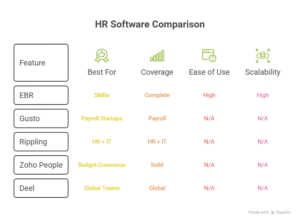
For most SMBs that want complete HR coverage in one place, EBR is the strongest starting point.
For payroll-focused startups, Gusto makes sense. For HR plus IT management, go with Rippling. Budget-conscious businesses will get solid value from Zoho People. Global and remote teams should look at Deel.
But for all-round coverage, ease of use, and room to grow — EBR is the one to start with.
Frequently Asked Questions
What is the best HR software for small businesses?
EBR is the strongest all-round option for most SMBs in 2026. A single platform integrates payroll, onboarding, leave, compliance and performance without the complexity of enterprise systems.
What is the difference between HR software and payroll software?
Payroll software handles one specific function — calculating and processing pay. HR software covers the full employee lifecycle, from hiring through to offboarding. Many HR platforms include payroll as one of several features.
How long does it take to implement an HR system? I
t depends on the tool and the size of your business. Simple tools like GoCo can be running in a day or two. More comprehensive platforms like Rippling and Paycor most likely will need a few weeks to become properly configured.
What is the most budget-friendly HR software for very small teams?
Zoho People is the most affordable full-featured option. Homebase also has a free tier that works well for very small hourly teams.
Can HR software integrate with my benefits provider and accounting systems?
Most modern HR platforms do. Be sure to verify which specific integrations will be available to you before making any commitment, especially with your accounting software and any benefits platforms you currently use.
Is free HR software available for small businesses?
Some tools offer free tiers with limited features. Homebase is the most notable. For anything beyond basic functionality, a paid plan is usually necessary. Most platforms offer free trials so you can test before committing.
Do these systems offer mobile access?
Yes, all the tools on this list have mobile apps or mobile-optimised interfaces. Paylocity leads on mobile experience, but most platforms cover the basics — payslips, leave requests, and employee self-service — on mobile.
Is mobile access important for HR software?
It depends on your workforce. For desk-based teams, it’s a nice-to-have. For field staff, remote workers, or shift workers, mobile access becomes far more important.
Conclusion
The right HR software saves time, reduces errors, and gives your team a better experience at work. For small and medium businesses, that’s not a luxury — it’s how you stay organised as you grow.
Every tool on this list is worth considering depending on your situation. But if you want one place to start, EBR gives SMBs the most complete HR solution without the enterprise complexity or the enterprise price tag.