Key Takeaways
- Different industries face different inventory challenges, but the right software adapts to each one.
- Inventory management is one piece of a bigger picture that includes order, supply chain, aId warehouse management.
- The right system depends on your specific pain points, not the longest feature list.
How Inventory Management Software Benefits Different Industries
Every industry handles inventory differently. Here’s how the right software helps in each one.
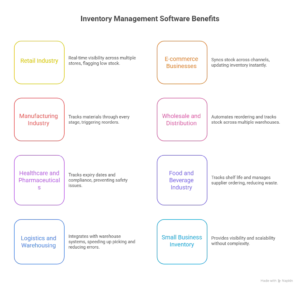
Retail Industry
Retailers juggle stock across multiple stores. Knowing what’s where, and when to reorder, is the difference between a sale and a missed one.
Inventory software gives real-time visibility across every location. It flags low stock before shelves go empty.
E-commerce and DTC Businesses
Online sellers face a different challenge. Stock needs to sync across channels in real time, or you sell things you don’t actually have.
Good software connects to your storefront, marketplaces, and fulfillment centres. It updates stock the moment a sale happens.
Manufacturing Industry
Manufacturers manage raw materials, work-in-progress, and finished goods all at once. A shortage in raw materials can stall production.
Inventory software tracks materials through every stage. It triggers reorders before shortages happen.
Wholesale and Distribution
Wholesalers move large volumes through complex supply chains. Margins are thin, so efficiency matters a lot.
The right software automates reordering based on real demand. It tracks stock across multiple warehouses too.
Healthcare and Pharmaceuticals
Healthcare inventory carries serious stakes. Expired medication isn’t just a cost problem — it’s a safety problem.
Software tracks expiry dates, batch numbers, and compliance requirements automatically. It flags items before they become a liability.
Food and Beverage Industry
Perishables make inventory especially time-sensitive. Waste is expensive, and running out of key ingredients stops service entirely.
Software built for this tracks shelf life and manages supplier ordering. Less waste, fewer last-minute calls.
Logistics and Warehousing
Warehouses deal with constant movement — goods in, goods out, stock shifting between zones. Manual tracking can’t keep up at scale.
Inventory software integrates with warehouse systems to track exact locations. It speeds up picking and reduces errors.
Small Business Inventory
Small businesses often start with spreadsheets. That works for a while.
It breaks down fast as product lines grow. Affordable inventory software gives small businesses the same visibility larger companies have, without the complexity.
Key Benefits of Inventory Management Software

The biggest benefit is accuracy. You always know what you have, where it is, and when to reorder.
Cost savings follow closely. Less overstocking means less cash tied up in unsold goods.
Time savings matter too. Automated reordering removes hours of manual work every week.
Better forecasting comes from clean historical data. You can spot seasonal trends and plan ahead with confidence.
And for growing businesses, scalability is huge. The right system handles 10 products as easily as 10,000.
Common Inventory Management Software Features and Workflows
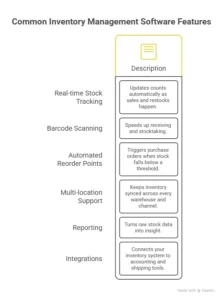
Most systems share a core set of features.
Real-time stock tracking updates counts automatically as sales and restocks happen. Barcode scanning speeds up receiving and stocktaking.
Automated reorder points trigger purchase orders when stock falls below a threshold. Multi-location support keeps inventory synced across every warehouse and channel.
Reporting turns raw stock data into insight. And integrations connect your inventory system to accounting and shipping tools, so data flows automatically.
How Inventory Management Differs From Related Processes
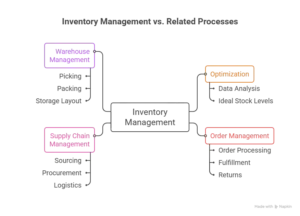
These terms get used interchangeably a lot. Here’s what each one actually means.
Inventory Management vs Optimization
Inventory management is the day-to-day tracking of stock levels and movement. Optimization goes further — using data to determine the ideal stock levels for every product.
Management keeps things running. Optimization makes them run efficiently.
Order Management
Order management focuses on the customer side — processing orders, fulfillment, and returns.
Inventory tells you what you have. Order management handles what happens once a customer wants it.
Supply Chain Management
Supply chain management is the bigger picture — sourcing, procurement, and logistics across the whole journey.
Inventory management is one piece of that puzzle.
Warehouse Management
Warehouse management focuses on physical operations — picking, packing, and storage layout.
Inventory management tells you what exists. Warehouse management handles how it moves through the building.
Inventory Management Methods, Techniques, and Types
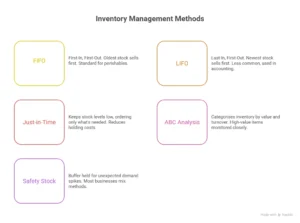
There’s no single right way to manage inventory. The right method depends on your business model.
FIFO assumes the oldest stock sells first. It’s standard for perishables and anything with an expiry date.
LIFO assumes the newest stock sells first. It’s less common, used mainly in specific accounting scenarios.
Just-in-time keeps stock levels low, ordering only what’s needed right before it’s needed. It reduces holding costs but needs reliable suppliers.
ABC analysis categorises inventory by value and turnover. High-value items get monitored closely, low-value items more loosely.
Safety stock is a buffer held for unexpected demand spikes. Most businesses mix these methods depending on the product.
Calculating Inventory Management
A few core calculations drive most inventory decisions.
Inventory turnover ratio measures how often stock is sold and replaced. It’s cost of goods sold divided by average inventory value.
Reorder point tells you when to place a new order. It’s based on daily usage multiplied by lead time, plus a safety buffer.
Economic order quantity calculates the ideal order size. It balances ordering costs against holding costs.
Days of inventory outstanding shows how long stock sits before it sells. Lower numbers usually mean healthier flow.
Good inventory software calculates all of this automatically.
How Do You Choose the Right Inventory Management System?
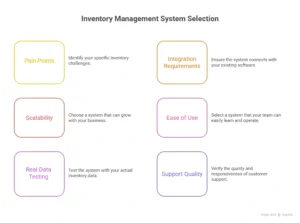
Start with your specific pain points. Is it stockouts, overstocking, or manual reporting? The right system depends on what’s actually causing problems.
Check integration requirements early. Your software needs to connect with accounting, e-commerce, and shipping tools.
Think about scalability. A system that works now should still work as you grow.
Look at ease of use. If it’s too complex, your team won’t use it properly.
Test with real data before committing. Most providers offer a free trial — use it.
And check support quality. When stock data goes wrong, you need fast help, not a slow ticket queue.
Frequently Asked Questions
What are the benefits of using inventory software?
Real-time stock visibility, fewer stockouts and overstocks, automated reordering, and significant time savings on manual tracking.
What are the benefits of AI in inventory management?
AI improves demand forecasting, flags unusual stock patterns, and suggests optimal reorder quantities based on historical trends.
What is the best reason to have inventory software?
Accuracy. Knowing exactly what you have and when to reorder removes the guesswork that leads to lost sales and wasted cash.
What is the primary purpose of using an inventory system?
To track stock accurately across every location and channel, so businesses can fulfill orders without tying up excess cash.
Why do businesses need an inventory management system?
Because manual tracking doesn’t scale. As product range grows, spreadsheets become slow and error-prone.
What industries use inventory management software?
Retail, e-commerce, manufacturing, wholesale, healthcare, food and beverage, logistics, and small businesses across almost every sector that holds stock.
Conclusion
Inventory management looks different in every industry. But the core problem is the same — knowing what you have, where it is, and when to act.
The right software solves that. It replaces guesswork with data and gives your team the visibility to make smarter decisions every day.
At EBR Software, we help businesses get their inventory under control — from setup to ongoing support as your business grows.